
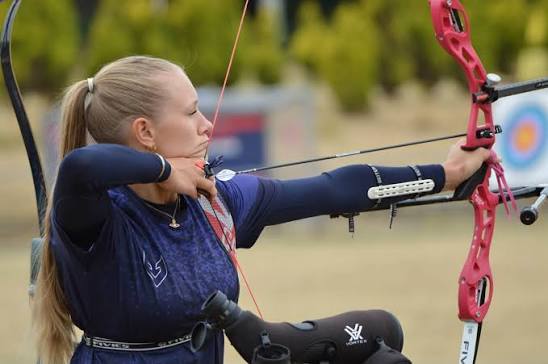
No one will argue a dislocated knee is an awful blight on the body. But for Emilia Hughes, it offered her an opportunity that would transform her journey to becoming a double European champion.
“I did a beginner’s course with my dad and my nan. At the time I played hockey and then unfortunately I had an accident where I dislocated my knee, which then meant I was in a wheelchair for two months. You could actually do archery in a wheelchair, so I stuck at it. I started in 2017, and it was probably 2019 when I went to the national championships. I saw people win and I thought, I want to be there one day, that was the end goal for me. I just wanted to win.”
And while bound to the wheelchair, still recovering from the injury, Emilia made a decision that changed her life.
“I thought, okay, I’ve got an opportunity here, I better take it.”
For Emilia, competition is also about the pure emotion of standing against the target, and pressure is something to which her attitude has certainly evolved since her debut.
“My first international competition was in 2022 in Romania. I remember I was petrified, I was so nervous to the point where I couldn’t enjoy it because I wanted to do so well.” Hughes placed 21st out of 50 competitors ranging from all across Europe.
That was also the first tournament in what has become a half-decade long career with the Team GB squad for the now 20 year-old.
“My first selection, I was ecstatic. That was like my biggest dream and then being able to achieve that was crazy. But obviously then your goals change, then you want the next thing, then you want to win a medal.”
The apple of every athlete’s eye was now firmly dangling over the proverbial target, and Emilia began to improve. Following on from Bucharest, she returned to the UK for European Youth Championships in Lilleshall, improving to a final placement of ninth including victory over fellow Briton Megan Havers. In Slovenia’s Veronica’s Cup she was one point away from a bronze, eventually losing her fifth set by the slimmest of margins.
2024 approached, and still yet to win a medal she entered the European Youth Cup – the tournament she’d made her Team GB debut in 2 years earlier. Emilia describes it as, “that feeling of if you’re in a gold medal match, you know you’re going to walk away with at least silver and it’s really nice to feel like I’ve achieved something with all I’ve put in because it’s hard to get.”
Her first gold-medal match against France’s Maia Ticu on the 21st of April that year saw consecutive 7-3 scorelines in her first two matches that led her to a quarter final where she dominated 6-0. On this occasion though, silver would be her result, as she found herself on the other end of the same scoreline that had seen her progress through her first two matches.
She’d compete on three more occasions before heading into an entirely new discipline, having competed virtually all her life she recently made the switch to outdoor archery.
“The target is Olympic standard archery. Ultimately you stand on the line and shoot 17 metres away, for seventy-two arrows, and then you shoot up in stages of matches, so there’s multiple points where you could knock them out. Field archery is completely different.”
“Qualification is over 2 days, with 24 targets each day and it can be anywhere from 10 to 60 metres away. Your target face size changes, from 20 centimetres to 80 centimetres, so it’s a different format, different layout, and then it can also be on different angles. They’re often set like in hills or mountain sides, so you get different angles and then that adds another element into it.”
Essentially, it’s a whole different learning curve than the discipline used in the Olympics, and heading into this tournament Emilia lacked the experience of many of her peers,
“I only started field archery last year. Europeans was my first international competition, and before that I’d only done 3 competitions in field.”
“I shot the last arrow of that match and I needed a six, which is the middle of the target. I shot a 6, but it was on the line. I didn’t know whether I’d won until the judge called it up on the target.. That was the scariest one for me because I couldn’t quite celebrate, even though I thought I’d won.”
But win she had, and against an opponent in Tereza Veverkoza, who she’d never beaten to that point in her career. In Sofia a single arrow had defeated her, this time it had flown straight, and crowned her European Champion. Together with Edward Gray they dominated the mixed team event, doubling her medal count and returning home with two golds on her first try.
“I obviously wanted gold but I felt like I couldn’t say that because you don’t want to set your goals too high.
“I felt really good going into it and I trained really hard for it and then I got there. Qualification was pretty good, I qualified second and then I shot really well in my semi-final and then I ended up taking the gold.”
Archery may yet be one of the more niche sports on offer to the world, but that doesn’t mean it’s hard to start practicing, Hughes explains. “You can go onto Archery GB and find a club where you can do a taster session. I really want to see more younger people getting into the sport, and I also would like to see more funding in the sport.
“Archery is not a well-watched sport, people don’t find it that interesting, but I compare it to golf. I think if people want to watch golf and there’s a lot of money in that, I think that there’s potential to be a lot of good money in archery.”
At 21, she’ll graduate to the senior competitions, where the strength of field improves and everything becomes that little bit more serious. “I was so excited, I’ve never trained that hard in my life for any city because I’ve now aged out. So I’m a senior now and that was my last competition as an under 21.
“I really wanted to win the world champs. Anybody does, naturally. But the way I explained it to my family is I said, look, of course, you can want to win something, but it doesn’t make it realistic. But going into that, I felt like I had to win. And unfortunately, it just wasn’t my day.” Seeded second after qualifying, she would only reach the quarter finals before bowing out to Czechia’s Tereza Veverkova.
Still, to call oneself a double European champion, and World vice-champion is more than most could ever do, even in her own sport. Ultimately, in Emilia’s own words, “It proves that all of the hard work and sacrifices especially, that’s the side that people don’t see, everything has been worth it. I’ve succeeded and achieved the goals I want to achieve.”
Follow along for live blog updates here:


